
The Crusades
“Then Jesus said to him, “Put your sword back into its place. For all who take the sword will perish by the sword.”
— Jesus · Matthew 26:52Popes preached war as pilgrimage, and Europe marched — Jerusalem taken in 1099 with its garrison and inhabitants put to the sword in the name of the Prince of Peace.
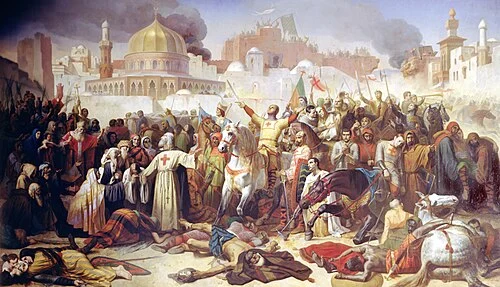
Image credit & licence
Émile Signol · Public domain · http://nobility.org/wp-content/uploads/2012/05/Jerusalem.jpg
Original image and licensingIn 1095 a pope promised paradise to anyone who would take up arms for the Holy Land, and for two centuries Europe answered — sacking Jerusalem in 1099, slaughtering its Jewish and Muslim inhabitants, and carrying the same logic into the Baltic and against heretics at home. The men believed they were doing penance. That is the entry's core horror: the violence was not a betrayal of their framework, it was licensed by it.
The context is stated fairly — the crusades answered real conquests of Christian lands, and some motives were sincere. But the standard that condemns them was in their own saddlebags, spoken by the man they marched for: put up again thy sword. A faith whose founder refused the kingdoms when they were offered spent four centuries trying to take one by force.
This label distinguishes a factual historical record from the interpretation built around it. A well-documented event or influence pathway does not prove that no alternative history could produce a similar result. Grade note: the historical record and pathway are especially well established
The context, fairly stated: the Crusades answered real conquests of Christian lands, and the participants sincerely believed they were doing penance. The standard that condemns them is the one their own Scriptures gave them.