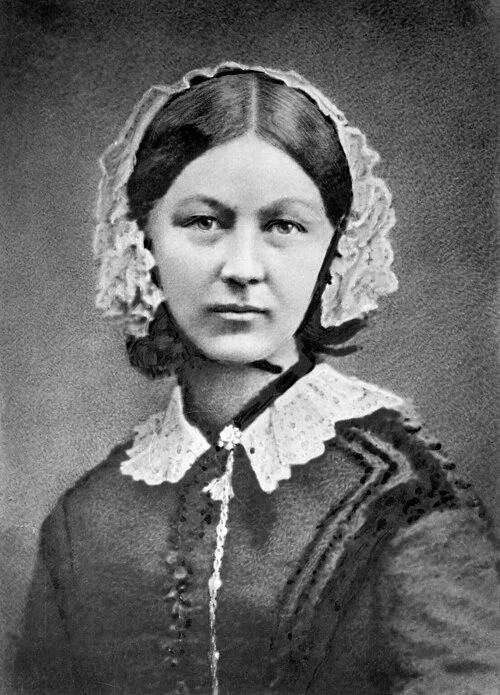
At seventeen she wrote in her private diary that God had spoken to her and called her to service. What followed — Scutari, sanitation, statistics, the world's first secular nursing school — reads like one long act of obedience to that sentence. Her later faith was idiosyncratic and she distrusted institutions; the calling and the work are the documented part.
EVIDENCE VS. COUNTERFACTUAL
This label distinguishes a factual historical record from the interpretation built around it. A well-documented event or influence pathway does not prove that no alternative history could produce a similar result. Grade note: a substantial pathway, with important contributing streams
STRONGEST OBJECTION(S)
She also distrusted organized religion late in life; the calling and the institution-building are documented, the churchmanship is not the claim.
The causal chain — tap (i) for detail
01A documented sense of divine calling (1837) Nightingale’s account of a divine call gives evidence for how she understood an obligation to serve. It helps explain her motivation without supplying a complete explanation of nursing reform. Family circumstances, training, observation and practical opportunities also mattered in translating a personal religious conviction into work that other people could organise and teach.
02Crimea: sanitation saves more lives than medicine (1854–56) Her Crimean work placed the conditions of military hospitals under scrutiny, including cleanliness, administration and the circumstances in which patients lived. Observation and statistical argument helped connect avoidable suffering with demands for reform. The significance of this stage lies in practical investigation and institutional criticism, rather than a simple contest between sanitation and medical treatment.
03The profession keeps the vocational shape Training and professional organisation made nursing a field whose standards could be transmitted beyond one exceptional practitioner. A sense of vocation remained important to many nurses, with or without religious belief. That continuity concerns commitment to the patient; it does not mean the profession remained under church control or that its members shared Nightingale’s theology.PRESENT DAY