
Case WJ-P03 · Hall of fame
THE HALL OF FAME › JOHANNES KEPLER
Johannes Kepler
1571–1630 · PRIMARY FIELD: SCIENCE & TECHNOLOGY
ENGLISH STANDARD VERSION (ESV)
“Oh, the depth of the riches and wisdom and knowledge of God! How unsearchable are his judgments and how inscrutable his ways!”
— Paul · Romans 11:33He found the laws of planetary motion while insisting the heavens were a book God had written in the language of mathematics.
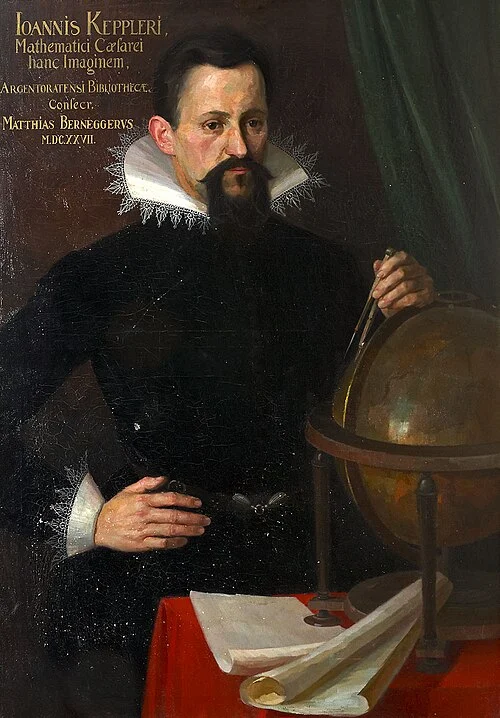
Johannes Kepler — the heavens as God's mathematics
Image credit & licence
August Köhler [1] · Public domain · Kepler-Museum in Weil der Stadt
Original image and licensingTHE RECORD, PLAINLY
The record, plainly: he was excommunicated from his own Lutheran church for refusing to sign a statement he thought unscriptural, and kept the faith anyway — conscience over communion.
EVIDENCE VS. COUNTERFACTUAL
This is an interpretive synthesis: the sources support elements of the story, but the overall causal weight remains open to historical debate. Grade note: the influence pathway is well documented; replacement remains a separate question
The causal chain — tap (i) for detail
01A Lutheran's conviction that creation is mathematical Kepler's religious outlook encouraged him to seek mathematical order in the heavens. He expected the structure of creation to be intelligible, making geometry a source of questions and hypotheses. Those expectations shaped his research, but the history also shows how an appealing initial picture could be challenged by the demands of astronomical evidence.
02Mysterium Cosmographicum (1596) The Mysterium Cosmographicum proposed a geometrical arrangement for planetary distances, expressing Kepler's search for an underlying cosmic design. Its specific model did not become the final account of planetary motion. The work mattered as an early programme of investigation and a route into scholarly exchange, rather than a fully formed version of his later laws.
03The three laws of planetary motion Working with Tycho Brahe's observations, Kepler developed descriptions of planetary motion that departed from inherited expectations about perfect circles. Ellipses and changing orbital speed made the mathematical account fit the observations more closely. The stage illustrates a productive tension between a researcher's philosophical hopes and the discipline required to revise a model.
04The foundation Newton built on Newton later supplied a dynamical framework that explained the principal orbital relationships Kepler had described. The connection joins different kinds of achievement: identifying patterns in observations and accounting for them through laws of motion and gravitation. Kepler's religious motivation belongs to that history, while the later explanation depended on additional mathematics and physical reasoning.
Sources
See also
Field X — Science & Technology→