“Jesus said to him, “Have you believed because you have seen me? Blessed are those who have not seen and yet have believed.””
— Jesus · John 20:29
VERY HIGH · EVIDENCE GRADE
A century's clearest case for Christianity — argued by an Oxford atheist who set out to refute it and was argued out of his unbelief — and then Narnia, which slipped the case past a billion defenses dressed as a children's story.
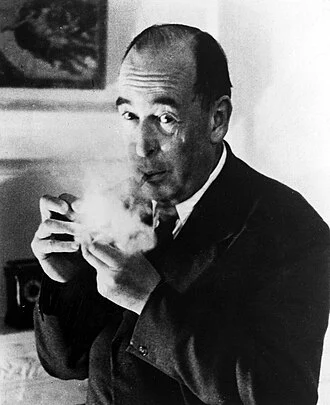
C. S. Lewis — the reluctant convert
Image credit & licence
John S. Murray · Public domain · Dust jacket of Lewis, C. S. (1957) Till We Have Faces: A Myth Retold. (1st ed.), Category:New York: Harcourt, Brace and Company Immediate source: raptisrarebooks.com/product/till-we-have-faces-c-s-lewis-first-edition-rare-fine-dust-jacket/. Higher quality version from Touchestonemag.com.
The record, plainly: his friends said he read his way to faith and his critics say he argued like a lawyer for it; both descriptions fit the man who wrote that the heart never takes the place of the head, but it can fight for it.
EVIDENCE VS. COUNTERFACTUAL
This is an interpretive synthesis: the sources support elements of the story, but the overall causal weight remains open to historical debate. Grade note: the historical record and pathway are especially well established
The causal chain — tap (i) for detail
01The most reluctant convert in all England — his own phrase Lewis's movement from unbelief to theism and then Christianity took place through reading, argument and relationships over time. His own accounts give access to how he understood that change, rather than a single moment that explains everything afterward. The sequence matters because his later apologetics drew partly on questions he had previously experienced as objections.
02Mere Christianity; the wartime broadcasts The wartime radio talks addressed Christian belief through a medium capable of reaching listeners outside a university or church service. Their later development into Mere Christianity extended that audience through print. The work's influence came through accessibility and continued discussion, while its arguments remain open to evaluation rather than validated by the size of its readership.
03The Narnia chronicles (1950–56) The Narnia books used stories, creatures and imagined worlds to explore themes recognizable within Lewis's Christian thought. Their appeal also depends on adventure, humour and character, so readers need not decode every episode as a proposition. The relationship between fiction and faith works through imaginative participation rather than replacing the stories with a theological outline.
04Modern apologetics and modern fantasy, from one desk Lewis's essays and fiction continue to reach partly overlapping audiences through different forms of reading. His apologetics offers explicit arguments, while the fantasy invites readers into a world whose moral order they experience narratively. That range explains a distinctive cultural reach without making him the sole founder of either modern Christian apologetics or modern fantasy.