“But when some became stubborn and continued in unbelief, speaking evil of the Way before the congregation, he withdrew from them and took the disciples with him, reasoning daily in the hall of Tyrannus. This continued for two years, so that all the residents of Asia heard the word of the Lord, both Jews and Greeks.”
— Luke (Acts) · Acts 19:9-10
HIGH · EVIDENCE GRADEFACTUAL RECORD
The university grew out of cathedral and monastic schools — Oxford from church schools, Paris from its cathedral school, Harvard (1636) founded to train ministers, Yale's charter naming ministry among its aims.
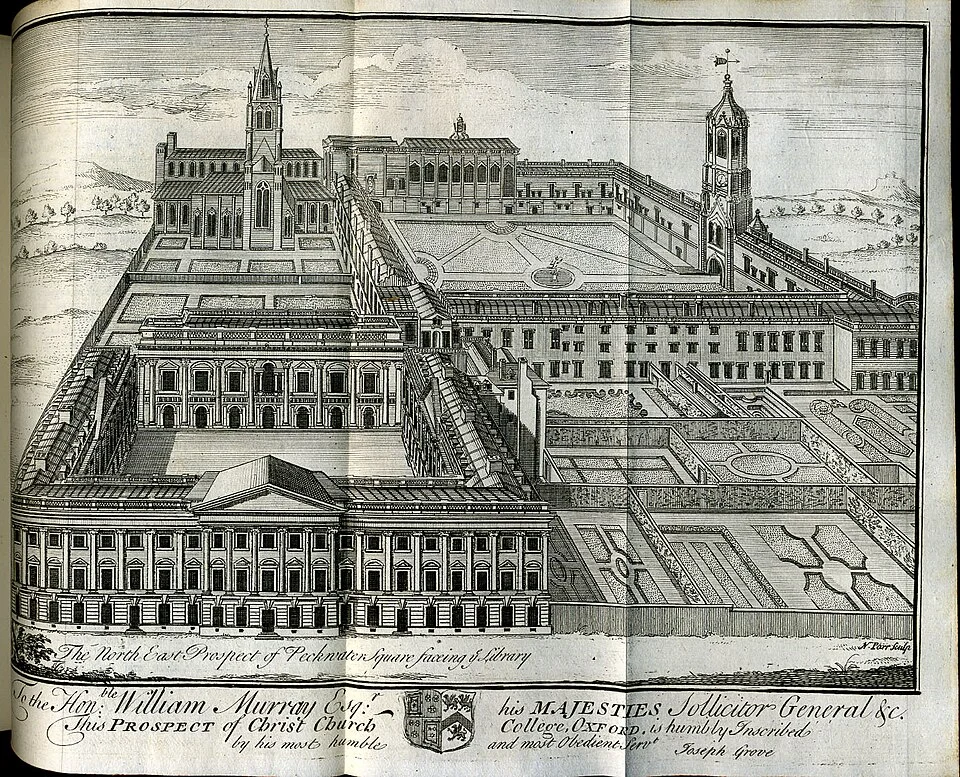
Oxford — from church schools to the university
Image credit & licence
Engraved by N. Parr · Public domain · Private collection of S. Whitehead
The medieval European university emerged in Christian societies, with important roots in cathedral and monastic schools and in the legal and intellectual institutions of medieval Europe. Its development also drew on classical learning, legal traditions, urban growth and Arabic scholarship. The university became globally influential, but that does not mean Christianity invented higher learning or that all universities followed one path.
Harvard's founders put their purpose in print in 1643 — dreading, they said, to leave an illiterate ministry to the churches. That is a mission statement. The objection, fairly stated, is that madrasas and Chinese academies existed first; the distinctively European invention is the self-governing, degree-granting corporation, and that is the thing that spread.
EVIDENCE VS. COUNTERFACTUAL
This label distinguishes a factual historical record from the interpretation built around it. A well-documented event or influence pathway does not prove that no alternative history could produce a similar result. Grade note: the influence pathway is well documented; replacement remains a separate question
STRONGEST OBJECTION(S)
Madrasas, Chinese academies and other forms of higher learning had their own long histories. The case here concerns the development and later global influence of the medieval European university form, not the invention of higher education.
The causal chain — tap (i) for detail
01Teach all nations — the teaching imperative Teaching occupied an important place in Christian life, from preaching to the interpretation of Scripture. That commitment created continuing demand for trained readers and teachers. The university was not prescribed directly in the Great Commission, but educational institutions developed within societies where these religious needs and aspirations were significant.
02Cathedral and monastic schools Cathedral and monastic schools taught forms of learning needed for religious and administrative life. They supplied part of the setting from which medieval higher education developed. Their role belongs alongside urban growth, royal patronage and the study of law and medicine, rather than forming a complete explanation by itself.
03The medieval universities: Bologna, Paris, Oxford, Cambridge Bologna, Paris, Oxford and Cambridge developed in different circumstances, with changing relationships to churches, rulers and towns. Their shared importance lies in durable communities of teachers and students, courses of study and practices of qualification. Christian institutions were deeply involved, although universities were never simply one uniform extension of a monastery.
04Harvard (1636) and Yale (1701) founded with ministry aims Harvard and Yale were founded in colonial societies wanting an educated ministry as well as wider learning. Their early religious purposes can be examined in their own documents. Later changes in curriculum, governance and belief show how an institution can retain a history while becoming very different from its founders’ intentions.
05Global university culture University culture spread through migration, empire, state policy and local educational ambitions, with substantial adaptation. Present forms have many contributors. The Christian connection is strongest in the documented history of particular institutions and practices, rather than a claim that every centre of advanced learning originated in the same tradition.